
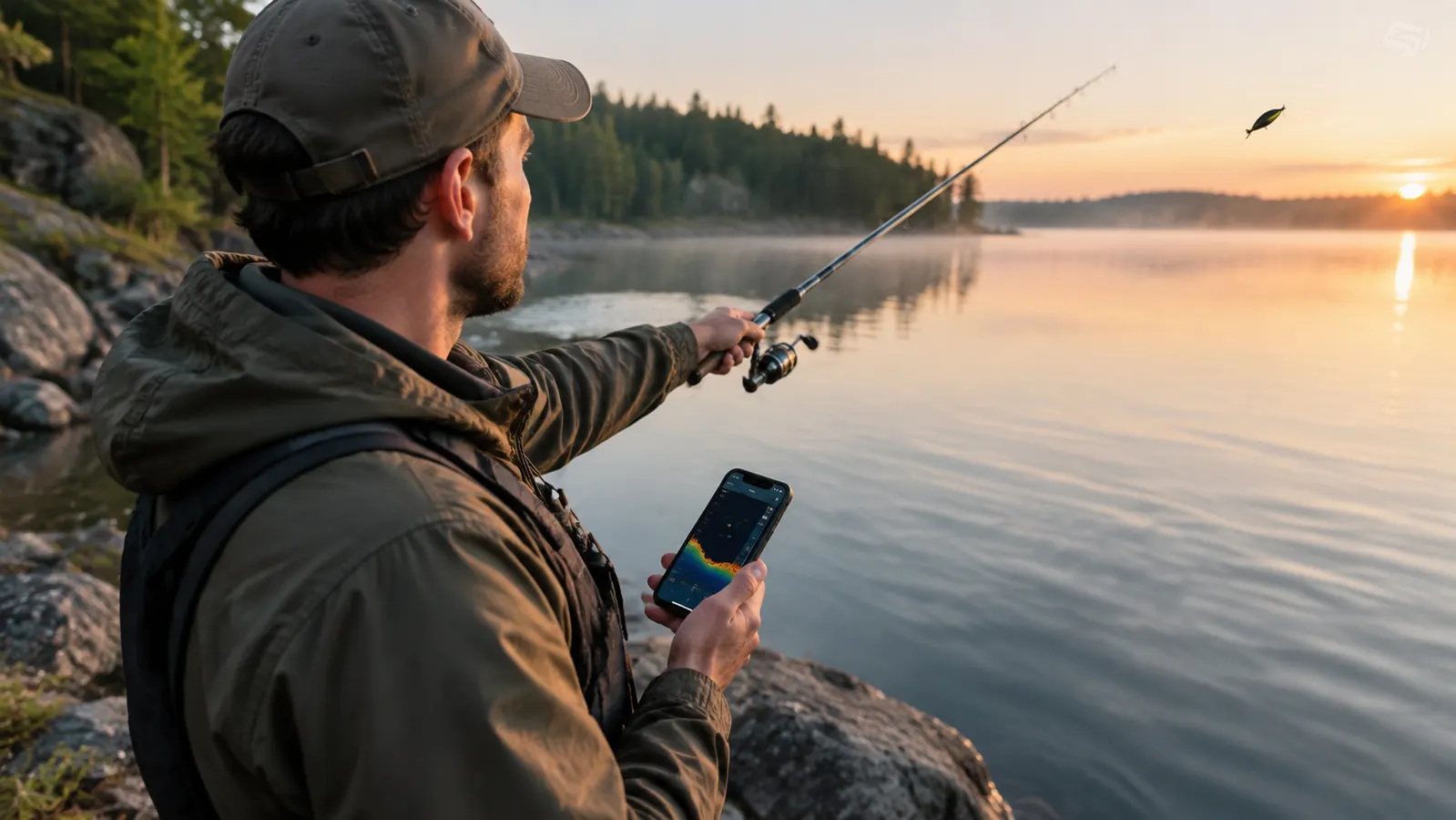
I have spent thirty-one years doing road maintenance and the last few of them learning how to fish the Yuba River and Rollins Lake from shore. Most of that time I did it blind. I would cast where the water looked right, where the current slowed against a rock, where the bank dropped off. Some days that worked. Other days I drove the hour home with nothing but a story about the one that got away. Last spring I finally got tired of guessing and bought the LUCKY portable fish finder, the castable one that floats and talks to your phone.
Denise and I take the Tacoma up to the Tahoe National Forest three or four times a season, three to five nights each trip. The boat stays on its trailer behind the truck. The fish finder goes in a soft pouch in the door pocket. That is the whole point of it for me. It is small enough that I forget it is there, and I have used it enough this year that I can tell you what it actually does and where it falls short.
The Quick Verdict
A castable sonar that is honest about what it is: a depth and structure finder for shore and small boat work, not a live bottom map. For what it costs it tells you where the drop-offs are, and that has made my trips shorter and fuller.
Amazon Check Today's Price →Stop casting blind on your next trip
If you fish from shore or a 14-foot aluminum boat like mine, the LUCKY portable finder puts a depth reading in your pocket for a fraction of what a boat-mounted unit costs. It floats, it casts, and it pairs with the phone you already carry.
Amazon Check Today's Price on Amazon →How I've Used It
I have run this LUCKY finder on about twenty trips since April, and I keep a little notebook in the truck to mark what it reads. The first dozen were from shore on the Yuba, mostly mornings before the heat came up. I would cast it out past the gravel bar, let it sit for a minute, and read the depth and the bottom on my phone. Then I would cast my bait to the same spot. On a good morning it changed where I threw my line inside the first half hour. On a bad morning it told me the water was flat and six feet deep, and I moved on without wasting a worm.
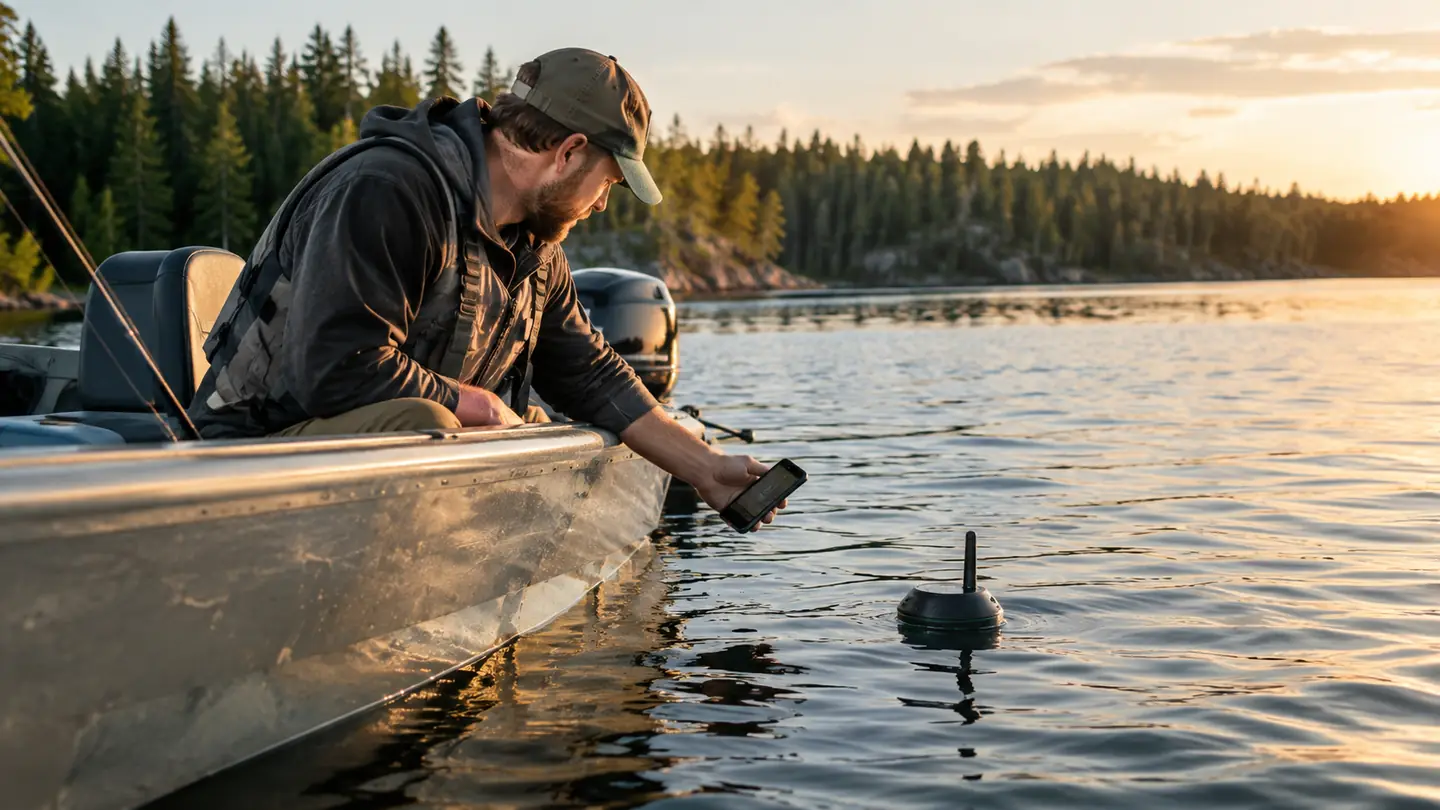
Later in the season I used it from the 14-foot aluminum boat on Rollins Lake, trolling it behind me at a slow idle while the outboard puttered. The transducer rides at the surface and the line goes slack when it settles, so the reading is steady once the boat slows down. I have also cast it from a dock at a friend's place, reeling it back a few feet at a time to map the drop. Each trip I logged a few spots in the app, and by August I had a mental map of two gravel bars and one underwater point that I would never have found by eye. That point, a rocky shelf off the west side of the lake, produced bass on three separate weekends.
The app matters more than I expected. It shows depth as a number, bottom hardness as a line, and vegetation as a lumpy trace. It also draws little fish icons when it sees a target. I have learned to treat those icons the way I treat a weather forecast: a suggestion, not a promise. Denise, who comes along on most trips, made that point the first time she watched me light up over a cluster of icons. The fish were not where the icons were, and she laughed, and now she reads the screen over my shoulder like a skeptic with a clipboard.
How the Castable Sonar Works
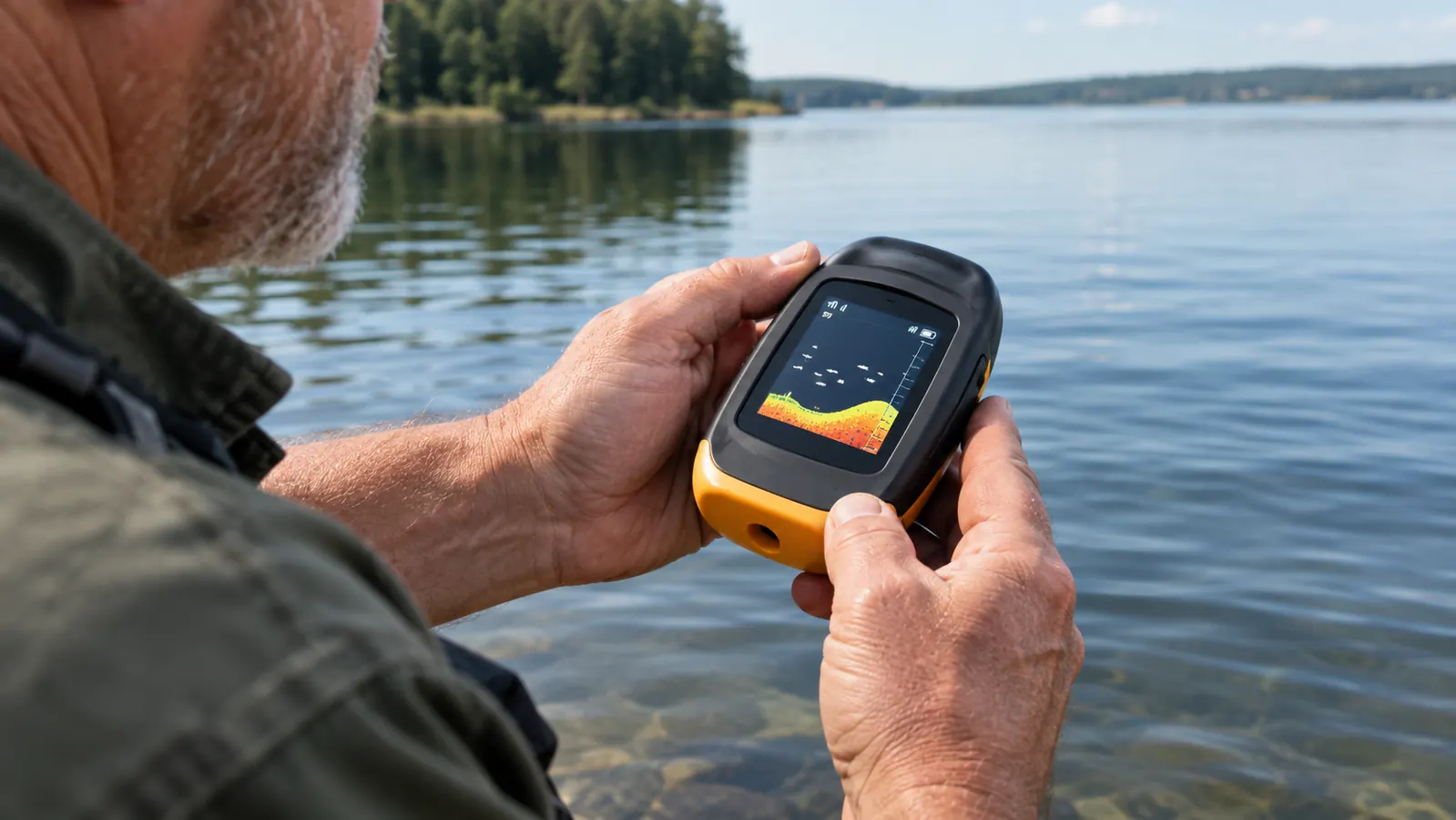
The LUCKY finder is a floating transducer on a line. You cast it like a lure, it lands and rights itself, and it sends a sonar cone down to the bottom. The phone app turns that into a picture. There is no separate receiver box, no wiring, no mount. That is the whole design, and it is the reason I keep it in the door pocket instead of leaving it at home. If a thing takes more than a minute to set up, I do not use it, and this one takes about as long as tying a hook.
The cone is narrow, so it reads a fairly small patch of bottom directly under the float. That sounds limiting, and it is. You are not scanning the whole cove. You are taking a reading of the spot where the float sits. You learn to move it, cast it again ten feet left, twenty feet right, and build a picture from a dozen dots. It is slower than a boat-mounted unit that draws a continuous line, but it is a lot cheaper and it works from anywhere. I would rather have twelve honest dots than one smooth line that only works when the boat is moving.
Depth range is plenty for the water I fish. On the Yuba it read down to about thirty feet without fuss, and on Rollins I never pushed it past that because the trout and bass are not that deep in summer. The app shows bottom hardness, which is how I found the gravel bar that held trout while the mud bottom beside it held nothing. Hard bottom reads as a bright line on the screen, soft mud reads as a thick faint band. Once you learn to read that, you stop fishing the mud.
What It Told Me From the Shore
The clearest win came in May on the Yuba. I had been fishing the same stretch for years, always from the same two or three spots. One Saturday I cast the LUCKY out past the gravel bar and it read fourteen feet of water with a hard bottom, while the flat water ten feet to my left read six feet of soft mud. I had walked past that drop-off a hundred times. I moved my bait to the fourteen-foot line and had two rainbows by mid-morning, both on the same worm. That morning paid for the finder in my mind, even though the finder had not caught the fish.
The second win was negative space. There is a long flat stretch below the bridge where I used to sit for hours because the bank was comfortable and the casting was easy. The finder showed it was six feet of featureless mud from one end to the other. I stopped fishing it entirely. That alone saved me more wasted mornings than I can count, and it is the reason I tell shore anglers to buy one of these before they buy a nicer rod. Knowing where not to fish is half the battle, and nobody tells you that in the aisle of the tackle shop.
I will be honest about the limits. From shore you can only reach so far, and the castable float does not like heavy wind. On gusty days the line bows and the float skips, and the reading gets jumpy. I learned to fish the protected coves on windy days instead of fighting it. The wind does not care about your depth finder, and I have learned not to argue with it.
On the Boat, It Earned Its Keep
The 14-foot aluminum boat with the small outboard is my other fishing platform, and this is where the LUCKY surprised me. Trolling it slowly behind the boat gives a steady depth line that a handheld unit cannot. One afternoon on Rollins I motored along the north shore at idle, watching the screen. The bottom came up from eighteen feet to eleven over about forty yards, then dropped back. I marked the shelf, anchored just above it, and caught three small bass on a plastic worm before dark. The finder did not catch them, but it put me on the shelf that held them.
I should say what it is not. It is not a live bottom map that draws your boat's path in real time. The screen updates slowly enough that you have to slow down or stop to get a clean read. At trolling speed it works. At planing speed it is useless, but my boat does not plane anyway. If you run a fast bass boat, this is not the tool for you, and I would tell you that to your face rather than let you find out on the water.
For a shore angler who also owns a small boat, one castable finder covers both. That is the real argument for it. A boat-mounted unit costs a lot more and only works on the boat. This one rides in the truck and works anywhere there is water, including the ponds I would never trailer the boat to. In June I used it at a pond near the house where I had fished blind for two seasons, and the first cast showed a drop to nine feet along the far bank that explained every bite I had missed.
Battery Life and the Small Annoyances
Battery life has been the biggest pleasant surprise. I charged it once in April and again in late July, and it never died on me in between. That is roughly twenty trips and a lot of idle time with the app open. The charge port is a small rubber flap that I worried about at first, but it has stayed dry through two rainstorms and a dunking off the dock. I charge it the night before a trip out of habit, the same way I charge the phone, and I have never once had it go flat on me.
The annoyances are real and I will list them. The float line tangles if you reel in carelessly, and untangling it on a riverbank in the dark is a two-handed job that costs you the best fishing light of the evening. The connection to the phone drops now and then, usually right after you cast, and you stand there watching the app spin before it reconnects. And because the app has to be open and in front of you, you cannot hold the rod and work the finder at the same time. It is a cast, reel in, check the phone, cast again rhythm, not a hands-free tool. If you picture yourself holding a rod in one hand and a phone in the other for a whole afternoon, you should picture that before you buy, because that is what it is.
What Else I Looked At
Before I settled on the LUCKY I looked at boat-mounted units and at the Humminbird PiranhaMax line, which is the other name you hear in tackle shops around here. The PiranhaMax is a proper fixed unit with a real screen and a transom mount, and it draws a continuous picture at speed. But it needs a battery, a mount, and a boat, and it does not help me from shore at all. I compared the two side by side if you want the full breakdown, but the short version is that they solve different problems, and my problem is mostly standing on a bank with a rod.
I also considered the cheaper castable models that show up in the same search results. The ones with a tiny screen on the float itself appealed to me because I could leave my phone in the truck. But the screens are small and hard to read in sunlight, and the range is shorter. The LUCKY's approach, using the phone you already carry, turned out to be the right trade for me. The phone screen is bright, the app is free, and I never have to remember to charge a separate device. My phone is coming with me anyway, so the finder might as well use it.
The honest version: if I fished only from a big boat with a trolling motor, I would buy a fixed unit and be done with it. But I fish from shore more than half the time, and the castable finder is the only tool that works for both. That is why it stays in the door pocket, and that is why, when a neighbor asked me in the tackle shop whether it was worth it, I told him to buy one and learn its limits before he judged it.
What I Liked
- Casts out a fair distance from shore, no boat needed
- Phone app shows depth, bottom hardness, and structure clearly
- Battery lasted from April to late July on a single charge
- Small enough to forget in the truck door pocket
- Reads steady when trolled slowly behind a small boat
Where It Falls Short
- You have to carry your phone and keep the app open
- The float line tangles if you reel in carelessly
- Fish icons are suggestions, not a guarantee of fish
- Connection drops now and then, usually right after a cast
- Two hands needed, so no way to hold the rod and the finder at once
The LUCKY finder has not put a single fish on the stringer by itself, and I would not expect it to. It has stopped me wasting the first hour of a morning casting over water that held nothing, and that is worth the price of admission on its own.
Who This Is For
Buy the LUCKY if you fish from shore, from a dock, from a kayak, or from a small boat that you row or idle around. It is for the angler who wants to stop guessing at depth and bottom structure without wiring a battery into the hull. It is for the weekend camper who packs light and wants one small device that covers every trip. If you are the person who reads a depth reading the way you read a campsite, slow and careful, you will get your money's worth in the first season. My neighbor, the one from the tackle shop, has already bought his own, and he fishes a stretch of the Yuba that I told him about after the finder showed it held water deep enough for trout in July. If you want the shorter version, the ten reasons a shore angler should carry one of these are written out in their own piece.
Who Should Skip It
Skip it if you run a fast boat and want a live map at speed, because it cannot do that. Skip it if you refuse to fish with your phone in your hand, because the phone is the screen and there is no way around that. Skip it if you want to see actual fish on a display, because the icons are guesses and the real value is depth and structure, not fish-counting. And skip it if you cannot be bothered to untangle a float line on a cold morning. It is a tool with limits, and the limits are part of the deal. I would rather tell you that plainly than have you learn it on the water and blame the finder for something it never promised to do.
The finder that rides in your door pocket all season
After a full season on the Yuba and Rollins, the LUCKY portable fish finder is still the first thing I grab with my rod. It does one job, it does it without fuss, and it costs far less than a boat-mounted unit. If you fish from shore, start here.
Amazon Check Today's Price on Amazon →