
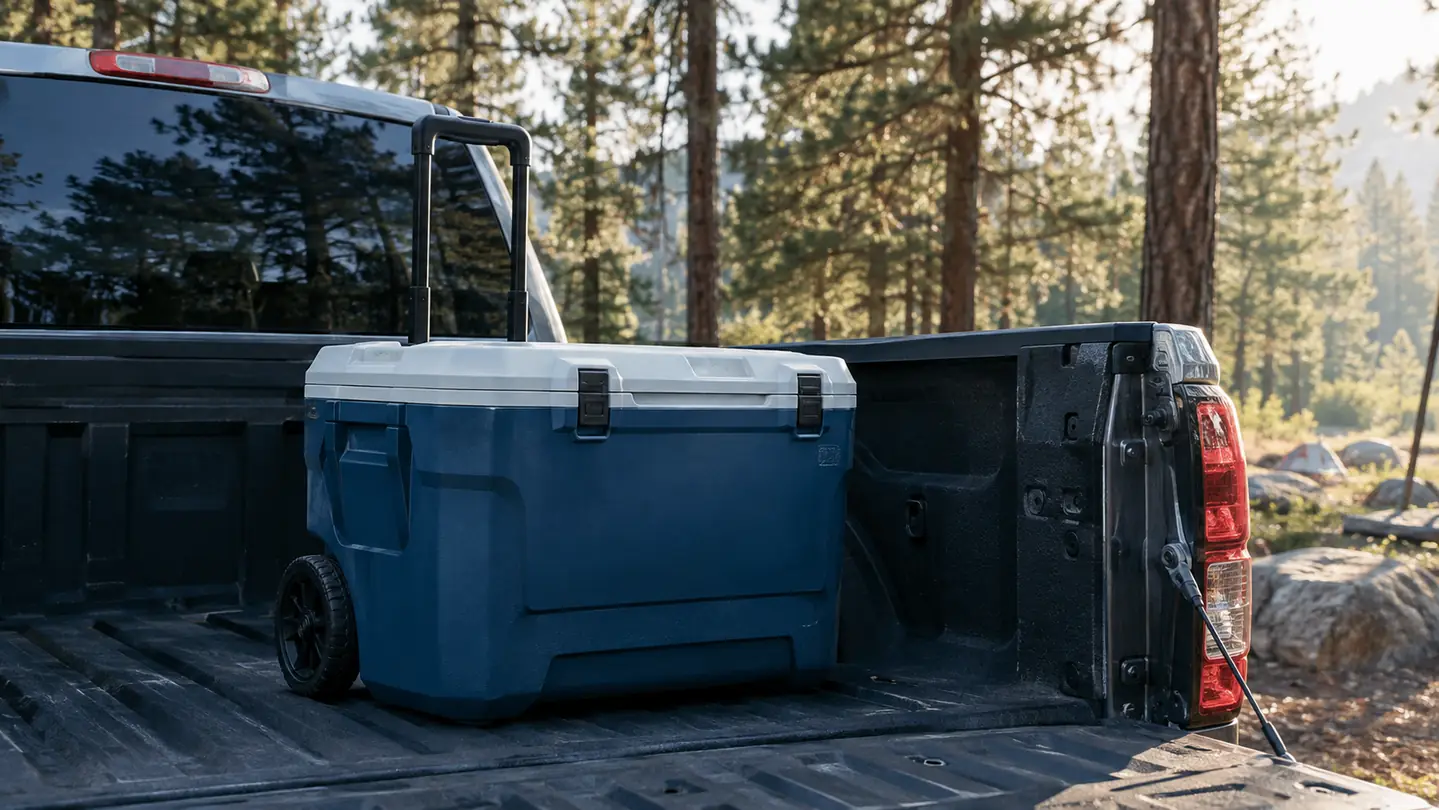
Most cooler reviews open with the ice claims, so I am going to open with the wheels instead, because that is where this Coleman surprised me, and not in a flattering way. The ice retention is real, mostly, and I will get to the honest numbers in a few paragraphs. But the parts that never make it into the product photos are the hard plastic wheels, the drain that sits low, and what actually happens when you load a cooler the way a real person loads a cooler. I have run this one for two full seasons out of the back of my 2014 Tacoma double cab, on the Yuba River and at Rollins Lake, and on car camping trips in the Tahoe National Forest with my wife Denise. This is the review I wish somebody had handed me before I bought it.
Coleman has been building coolers longer than I have been fishing, which is a long time. The Classic Series rolling cooler is the one stacked in every big box store in the state, and there is a reason for that. It is priced for a working person, it does what it claims well enough, and it has a few weak points that nobody mentions while you are standing in the aisle. Consider this the full confession, the things the box and the shelf tag do not tell you.
The Quick Verdict
A solid three day cooler that keeps ice well and rolls easy on flat ground, held back by plastic wheels and a drain that needs a tip to empty.
Amazon Check Today's Price →Worth it for weekend trips, once you know the catch
The Coleman rolling cooler holds ice through a three night campout and rolls easily on pavement and packed dirt. The wheels are plastic, the drain sits low, and the review below tells you exactly where it falls short before you spend your money.
Amazon Check Today's Price on Amazon →How I've Used It
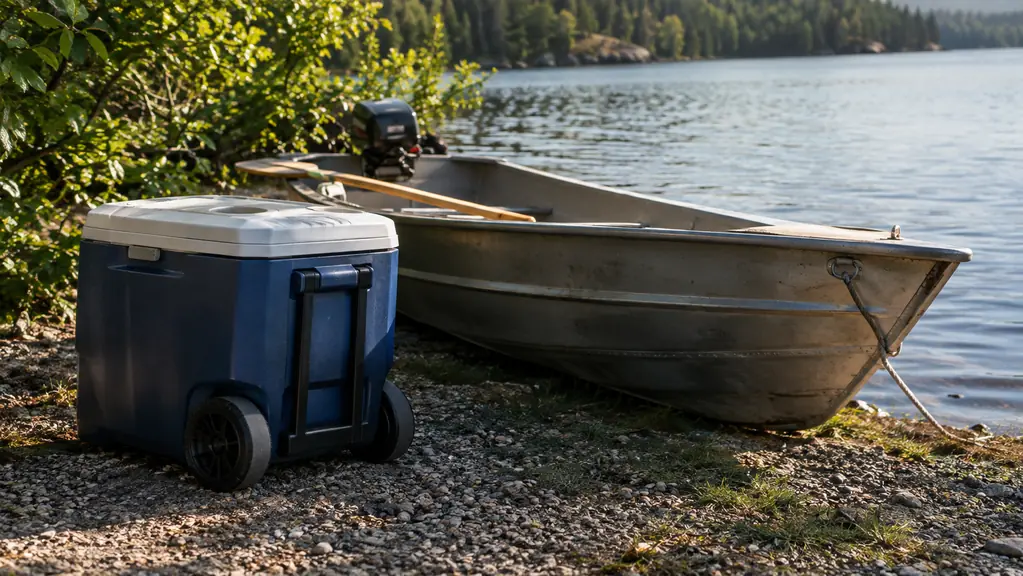
I run this cooler out of the bed of my Tacoma, where it lives between trips, strapped down with two bungee cords so it does not slide around on the way up the mountain. In two seasons I have taken it on more than twenty trips, most of them three or four nights in the Tahoe National Forest, plus a handful of day trips to Rollins Lake where it rides in the bottom of my fourteen foot aluminum boat. That is the whole point of this cooler for me, it has to be dependable for a long weekend, not for a week in the wilderness.
I pack it the way people actually pack a cooler, not the way the instructions suggest. A bag of ice on the bottom, drinks and meat in the middle, a second bag of ice on top, and the fragile stuff wedged around the edges. I open it eight or ten times a day when the fishing is slow. I do not pre chill the contents the night before, even though every article says you should, because that is not how my weekends work. I do not drain it every morning either. I drain it when I get home and I live with a little water in the bottom on day two.
The honest summary after two seasons is that it holds ice for about three days in a Sierra summer. In late May, when the nights drop into the forties, I have gone a full four days and still had ice to spare. In July at Rollins Lake, with the cooler sitting in the sun, three days is the real number, and on one bad weekend it was closer to two and a half. That range is the whole story in one paragraph, and it is the number you should plan your trip around.
What Nobody Tells You About the Wheels
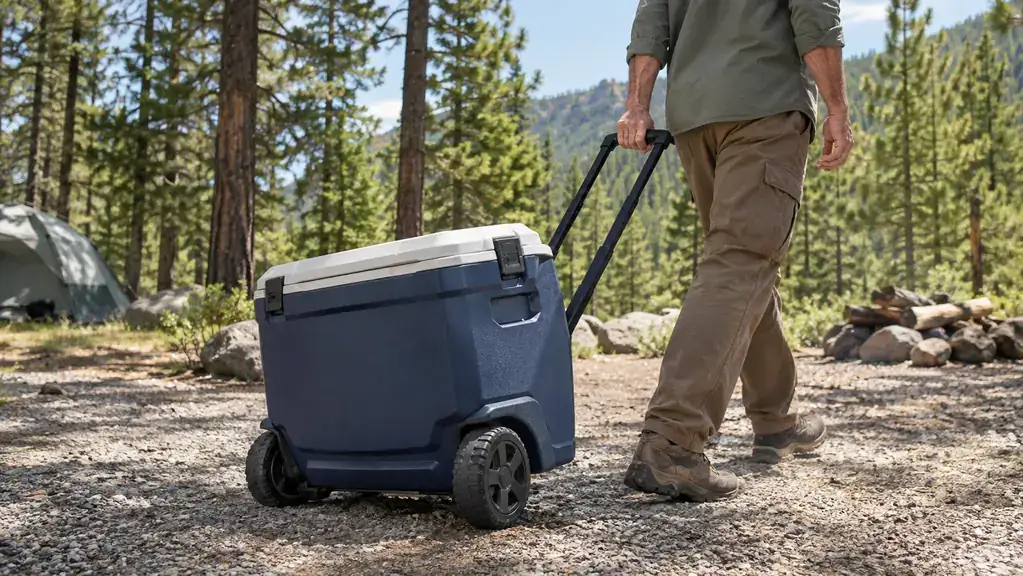
The wheels are the reason I sat down to write this review. They are hard plastic with no bearings, and on gravel they sing like a shopping cart with a bent wheel. On a smooth parking lot the cooler rolls easily, one hand on the handle, no effort at all. On the dirt road into my usual camp spot it rattles and fights, and it makes enough noise that Denise can hear me coming from a hundred yards away. I have learned to plan for that noise, but it still surprises people the first time they hear it.
The handle is a telescoping plastic bar that locks with a push button. It works, and it has held up fine, but the button has stuck twice in two seasons, and both times it happened when the cooler was full and the handle was carrying the full weight of fifty or sixty pounds. A tap with the heel of my hand freed it both times, but it is the kind of thing you want to know about before it happens at the far end of a carry, with the truck a quarter mile behind you.
The other thing nobody mentions is that the wheels are fixed, not swivel. That means the cooler tracks straight, which is great on a flat approach, but turning it on a narrow trail is a two handed job. You lift the front end, pivot, set it down, and repeat. In the bottom of a boat that gets old fast, and on a rocky shore it is worse. I have taken to dragging it by the front lip when I only need to move it a few feet, because that is easier than trying to turn it on the wheels.
The Drain Sits Lower Than You Expect
The drain plug sits low on one side, close to the bottom, which sounds like good design until you realize the cooler does not sit high off the ground. Sitting flat, the plug is about an inch above the dirt. To get the last of the water out you have to tip the whole cooler up on its end, which means lifting a heavy, wet, half full cooler and holding it there while the water runs out over your hands.
I learned this the hard way on the second trip. I pulled the plug while the cooler sat flat and about half the water came out before the flow slowed to a trickle. I tipped it up and the rest came out in a rush, running down the side and over my boots. In the truck bed it is not a problem, because I pull the plug and let it drain overnight with the tailgate down. At camp, on the ground, it is a two hand job and you will get wet. I keep an old towel in the truck just for this.
The plug itself has been fine. It has not leaked in two seasons, it seats firmly, and it has never popped out on a washboard road. My complaint is not the plug. It is the position of it, and the fact that emptying this cooler properly takes more work than the marketing lets on. Plan for that and you will not be surprised like I was.
Ice Retention, the Honest Numbers
I keep a loose log of ice retention because I am retired and I keep a log of everything. The best result was four days and about six hours, on a trip in late May when the nights dropped into the low forties and the cooler sat in the shade of the truck for most of the weekend. The worst was two days and a few hours, on a July trip when the cooler sat in direct sun on a gravel bar for most of a Saturday. Both numbers are true, and the gap between them is the real story.
The difference was sun, not air temperature. In the shade the cooler holds ice dramatically longer. In full sun all afternoon the ice goes fast. Coleman's four day claim is real, but it assumes shade and limited opening, and neither of those is how I camp. I open the lid to grab a drink, leave it open while I dig for dinner, and generally treat it like the working tool it is. The four day number is a best case, not a promise, and the three day number is what you should plan on in July.
The lid seal is the reason this cooler does as well as it does. The gasket runs the full perimeter and seats with a solid feel when you close it. I have never had water get into the cooler itself, and I have never had the lid pop open on a rough road. In my opinion that seal is doing more work than the insulation, and it is the part Coleman got right. If the seal ever wears out, the ice numbers will drop fast.
About That Leak Resistant Label
The box says leak resistant, and that is accurate as long as you mean the cooler itself. The body does not leak. The drain does not leak. What nobody tells you is that the condensation does. On a warm day the outside of the cooler sweats like any inexpensive cooler, and the sweat runs down and collects around the bottom edge.
Set it on a picnic table and you get a wet ring. Set it on the seat of my boat and you get a wet seat, and in a fourteen foot aluminum boat there is nowhere a wet seat is welcome. This is normal for a cooler at this price and it is not a defect, but it is worth knowing before you put it somewhere you care about, like the back seat of a car or a bench you plan to sit on for a few hours.
I have also had a small amount of water creep out around the lid on a hot day when the cooler was packed full. It is not a leak in the sense of a hole. It is melt water and pressure finding the path of least resistance past the gasket. The amount is small, it has never damaged anything, and a towel handles it, but it is there. I would rather tell you about it now than have you find it on your first trip and think you got a bad one.
How It Holds Up After Two Seasons
After two seasons and more than twenty trips, the cooler itself looks good. The exterior has scuffs from riding loose in the truck bed before I started strapping it down, but there are no cracks, no broken latches, and no warping. The lid still seats flat and the gasket still seals. For the price, that is better than I expected, and I have owned coolers that did not make it this far without a cracked hinge or a broken latch.
The plastic is thick enough that it does not flex when I lean against it, and the handles on the ends are molded in rather than riveted on, which means there is nothing to snap off. I have loaded a full case of water on top of it and driven over roads that would rattle the fillings out of your teeth. It has held up. That is the strongest thing I can say about any piece of gear.
The parts that will wear out first are the wheels and the handle button, both of which are simple plastic. Neither has failed on me yet, but I can see them being the first things to go. That is the tradeoff you accept at this price. The body will outlast the wheels, and when the wheels go, you are looking at a very heavy cooler that no longer rolls.
The honest number is three days in a Sierra summer, not the four on the box, and shade matters more than anything else.
What I Liked
- Holds ice for three to four days when kept out of direct sun
- Full perimeter gasket seals well and has never leaked
- Rolls easily on flat ground and pavement
- Drain plug has not leaked or failed in two seasons
- Sturdy body with molded handles, nothing to snap off
Where It Falls Short
- Hard plastic wheels with no bearings, noisy on gravel
- Handle button has stuck twice when the cooler was full
- Drain sits low and requires tipping the cooler to empty fully
- Condensation forms on the outside on warm days
- Fixed wheels make turning a two handed job
Who This Is For
If you camp out of a car, if your trips are three nights or less, and if you are replacing a cooler that finally gave out, this is a fair buy. It rolls on flat ground, it keeps ice for a weekend, it does not cost what a hard sided premium cooler costs, and one person can manage it on their own. For my kind of camping, out of the back of the Tacoma with the tailgate down, it is the right tool.
It is also a good cooler for a small boat if you are a shore angler or a small boat owner like me. It fits in the bottom of a fourteen footer, it does not slide around badly once you wedge it in, and the leak resistant claim holds up on the water. I have had mine on the Yuba River and at Rollins Lake all season, and the cooler itself has never let water in.
Who Should Skip It
If you need ice for a full week, skip it. If you drag your cooler over rough ground on every trip, skip it. If you expect the wheels to handle gravel the way they handle a parking lot, you will be frustrated by the second outing. The wheels are the weakest part of this cooler, and they are the part you cannot fix. Everything else on this cooler is solid. The wheels are the compromise.
I would also tell anyone who wants to sit on their cooler to look elsewhere. The lid is not built as a seat. I have watched the plastic flex under a heavier friend, and while it held, it was not designed for that job, and I would not count on it trip after trip. Coleman makes a model with a seat lid for that. Buy that one instead.
The bottom line on the Coleman rolling cooler
For weekend trips out of a truck, it is hard to beat at the price. Know that the wheels are plastic, know the drain needs a tip to empty, and keep it out of the sun, and it will serve you for years.
Amazon Check Today's Price on Amazon →