
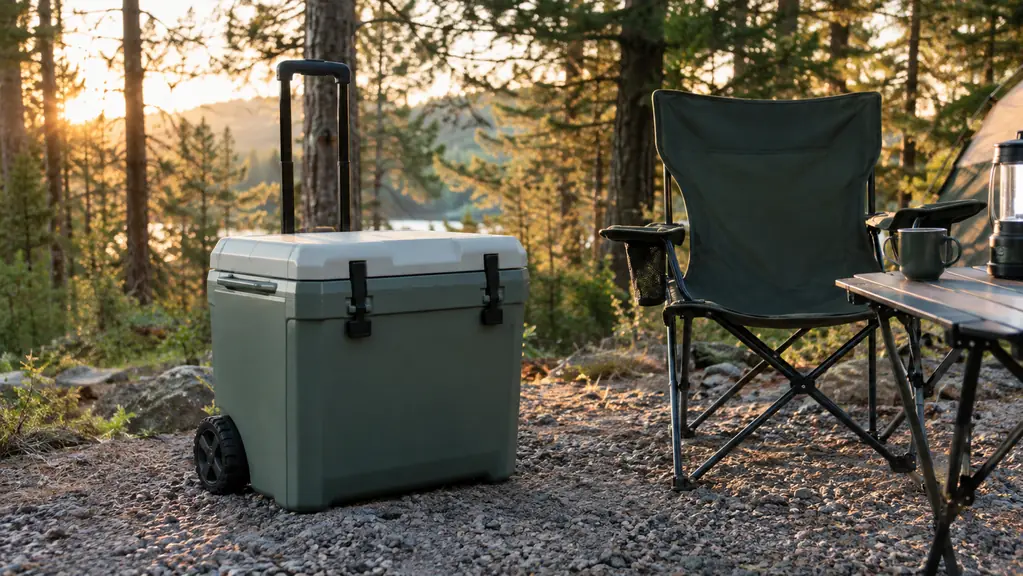
Back in April I loaded the Coleman Classic Series rolling cooler into the bed of my 2014 Tacoma and told Denise it would be the last cooler I bought for a while. That was a full season ago, seven trips into the Tahoe National Forest, most of them three or four nights at Rollins Lake or along the Yuba River. The cooler has been rained on, bounced over washboard gravel, sat in the sun on a boat dock, and hauled in and out of the truck bed more times than I can count. This is what I learned from a season of using it, not from reading the box.
I have owned a lot of coolers over thirty-one years on road crews and another handful of years fishing the Yuba and Rollins Lake. The cheap ones die in a season. The expensive ones keep ice fine but cost more than my first outboard. The Coleman sits in the middle, which is exactly why I wanted to see if it held up. A cooler that keeps ice for a weekend, rolls across gravel, and does not fall apart is worth knowing about.
The Quick Verdict
Kept ice for three full days in July heat, rolled over gravel all season without a wobble, and never leaked in the truck bed. Not the coldest cooler I have owned, but the one I reach for every trip.
Amazon Check Today's Price →A full season of ice tests, and one cooler that earned its spot in the truck bed
I used the Coleman Classic Series rolling cooler on every camping and fishing trip this season. If you camp the way I do, it is worth checking today's price on Amazon.
Amazon Check Today's Price on Amazon →How I've Used It
My season runs from the opener in late April through October, which is seven months of trips, most of them Friday afternoon to Sunday night. The Coleman went on every one. It carried trout I kept from the Yuba, bass from Rollins Lake, and the usual camp food: eggs, bacon, butter, a few steaks, and whatever Denise packed. On longer trips it held drinks for the first two days so the food stayed sealed.
I set it up the same way every trip. A bag of ice on the bottom, food in the middle, another smaller bag on top. Drinks went in a separate cheap cooler so we were not opening this one every half hour. With that routine, the Coleman kept ice for three days easily and made it to the start of day four on most trips. The box says up to four days. I got closest to that in May, when the nights were still cold and the cooler sat in the shade all day.
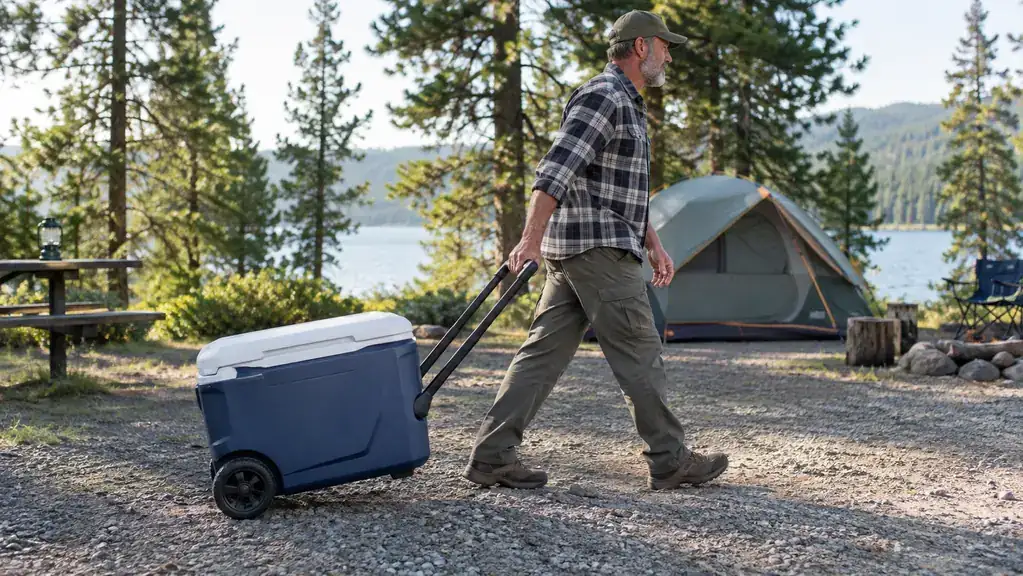
The wheels got the most work. Campsites at Rollins Lake are mostly gravel and pine needles, and the walk from the truck to the tent site is longer than it looks. I rolled this cooler over that ground more times than I can count. The wheels never wobbled, the handle never popped loose, and it never tipped over, even loaded heavy. Memorial Day weekend was the first real test. We drove up Friday night in the dark and set up near the boat ramp, and I left the Coleman in the truck bed overnight, which I normally would not do. It got down to the low forties. Saturday morning there was still ice in the bottom and the milk was cold. That was the trip I stopped worrying about whether the cooler would hold up and started using it like a normal piece of gear.
What Four Days of Ice Really Looks Like
The claim on the box is up to four days of ice retention. I tested that on a trip in late July when the temperature at Rollins Lake hit the high nineties. I filled the cooler with a full bag of ice, a dozen cans of soda, and the makings of two dinners, then left it on the picnic table in partial shade. By the morning of day three there was still enough ice to keep drinks cold, with meltwater at the bottom. By day four the ice was mostly gone and the food was cool but not cold.
That matches what I would tell a neighbour over the fence: count on three days of reliable ice and you will be happy. If you need a fourth day, keep the cooler in the shade, open it rarely, and drain the water once a day. I learned that trick after the July trip. Draining the meltwater through the plug kept the remaining ice from floating in a pool of warm water, and it bought me most of an extra day.
The lid seal matters more than I expected. The gasket on this cooler is thick enough that when you close the lid you can feel it seat. My old cooler never sealed right, and its ice died by the end of day two. The difference between a weekend cooler and a three-day cooler is mostly that gasket.
The first trip of the season I tried the opposite routine: keep this cooler sealed for drinks and put the food in the old cheap cooler. That plan failed by Sunday, because the cheap cooler's ice was gone by Saturday night and we opened the Coleman anyway. The next trip I switched the routine, food in this cooler, drinks in the cheap one, and the Coleman stayed closed most of the day. That is when it started hitting the three-day mark. The lesson was not about the cooler at all. It was about not opening it.
What Leak-Resistant Really Means
The first thing I checked when the cooler arrived was the drain. A cooler that leaks in the truck bed is worse than no cooler at all, because water finds its way into everything else. The drain plug on this one has a small knob you twist and pull. I have never had it come open on its own, even bouncing down the washboard stretch of Forest Service Road 12 between the highway and the lake.
Leak-resistant is not the same as leak-proof, and I found that out on a trip in September. I left the drain cracked open a half turn so the meltwater could run out while we were on the water. The water came out fine, but a little sloshed around the plug and dampened the floor of the truck bed. Nothing was ruined. I just learned to close the drain before driving and open it at the campsite.
The other thing worth knowing is the lid. It stays open when you lift it, and the hinge has not loosened up over the season. On a cooler this size that matters, because you are usually loading it one-handed while holding something else, and a lid that flops shut gets old fast.
The drain is also how I learned to dry the cooler at the end of the season. After the last trip in October I tipped it onto its side with the plug out and let it air out in the garage for two days. The inside is smooth plastic, so nothing stuck to it, and there was no smell when I closed it up for the winter. My old cooler spent every winter with a sour smell no matter what I did to it.
Rolling It Where You Need It
The wheels are what sold me on this cooler. I am fifty-eight, and my knees remind me of the thirty-one years on road crews. I do not want to carry a loaded cooler any distance. This one rolls. The handle pulls up and locks into place, and the wheels are wide enough that they do not sink into soft ground the way the little wheels on my old cooler did. From the parking lot to the far campsites at Rollins Lake, it rode behind me like a luggage cart.
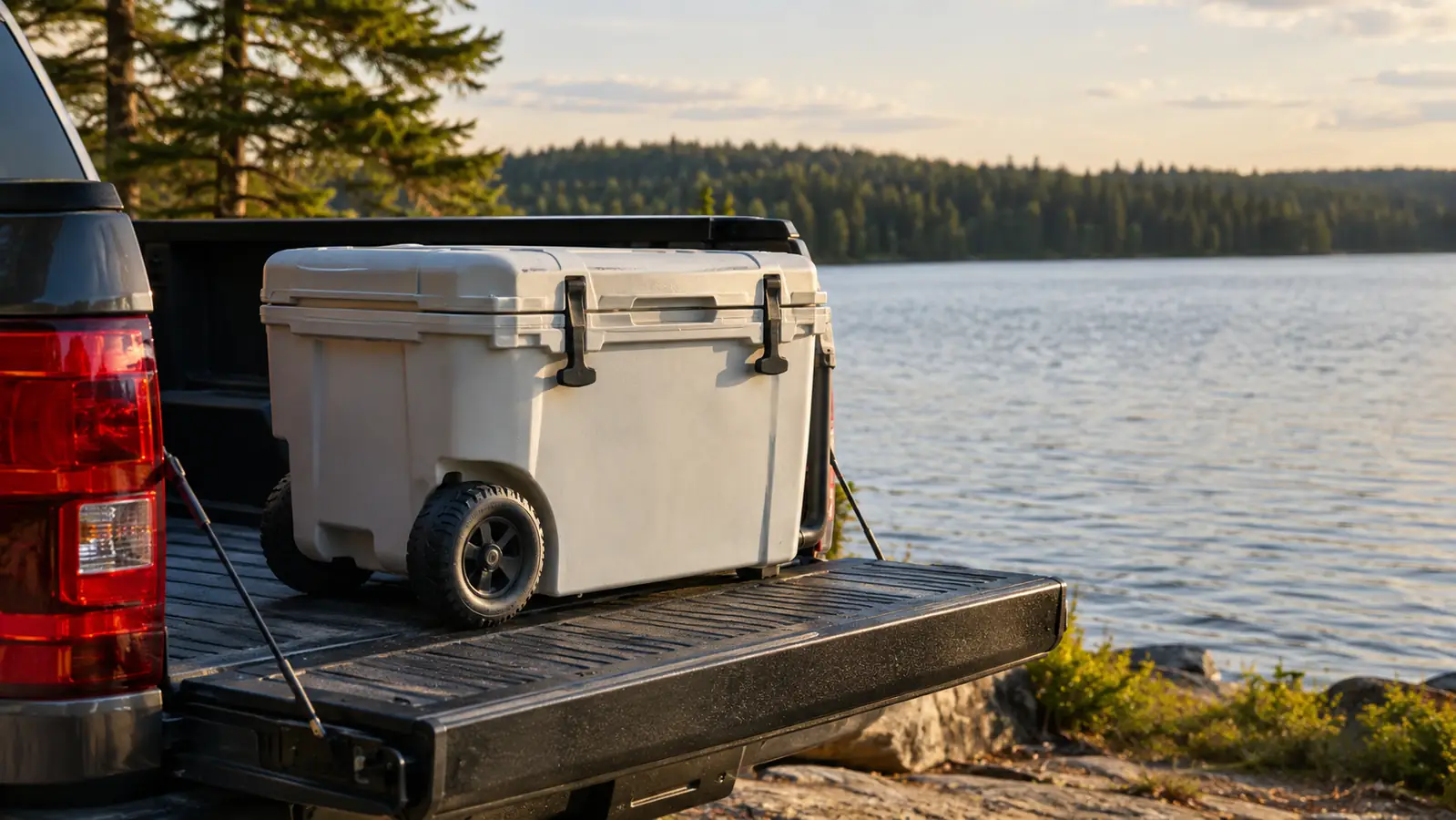
The tradeoff is that the wheels add height. The cooler sits about knee-high, which makes it awkward in the truck bed if you are trying to stack things on top of it. I usually set it on its side for the drive, with the handle tucked in, and stand it up at the campsite. That worked fine all season. If you pack your truck bed to the top, plan for it.
On the boat it is not ideal. The 14-foot aluminum boat does not have much floor space, and a rolling cooler is tall and boxy. I used it on the dock and in the boat a few times for drinks, and it did the job. But if most of your ice time is on the water, a low, wide cooler is easier to move around. I say that as someone who likes this cooler a lot.
The handle also survived the worst terrain I could find. The parking area for the best stretch of the Yuba is a quarter mile of loose rock and dry grass, and I rolled the cooler the whole way in on a trip last August. The handle stayed locked, the wheels stayed straight, and I did not have to stop once. My old cooler had a short fixed handle that banged my shins on every step. This one never did.
What I Would Change
Nothing is perfect, and this cooler has three things I would change. The first is the lid latch. There is one latch in the middle, and it is stiff when new. Denise could not always close it one-handed. It loosened up over the season, but the first few trips took two hands and a little patience.
The second is the height I already mentioned. In the truck bed it does not stack well, and in a small boat it takes up floor space. If you only use a cooler on a tailgate, you will not notice. If you pack a truck bed the way I do, you will.
The third is the handle grip. It works, and it locked every time, but the grip is hard plastic. On a long pull across a gravel lot my hand got tired. I wrapped a piece of pipe insulation around it for the last two trips, and that fixed it. A small thing, but worth knowing before you buy.
None of these are reasons to skip the cooler. They are the kind of small compromises every piece of gear has, and knowing them before you buy is better than discovering them at the campsite. I would buy this cooler again, and I usually do not say that about gear until it has survived a season.
What I Liked
- Kept ice for three full days in July heat, close to four in the shade with regular draining
- Wheels and handle survived a full season of gravel campsites without wobbling
- Drain stayed shut on washboard roads and never leaked in the truck bed
- Lid seals well and stays open when you need both hands
Where It Falls Short
- Single lid latch is stiff when the cooler is new
- Tall shape with wheels does not stack well in a truck bed
- Hard plastic handle grip gets uncomfortable on long pulls
Three days of ice in July heat, and wheels that never wobbled after a season of gravel. That is the whole review in one sentence.
Who This Is For
If you are a weekend camper or a shore angler who drives out Friday and is home Sunday night, this cooler is for you. It holds a weekend's worth of food and drinks, it rolls from the truck to the campsite, and it does not cost what the heavy rotomolded coolers cost. It is also for anyone whose old cooler finally died and who wants one thing that will last more than a season. It carried our food on every trip this year, and I never once wished I had bought something else. Denise used it as much as I did, and she never once complained about the latch after the first month. For a cooler that gets used by two people on every trip, that is a fair test.
It suited my setup, a Tacoma, a tent, and a 14-foot aluminum boat, better than I expected. It is the kind of gear you stop thinking about after the first trip, and that is the highest compliment I can pay a cooler. If you are weighing this against a YETI Tundra, the two coolers answer different questions, and the side-by-side comparison on this site lays it out clearly.
Who Should Skip It
If you need ice for four or five days in the backcountry, this is not that cooler. If you pack your truck bed to the top and need everything to stack flat, the tall wheels get in the way. And if you spend most of your time fishing from a small boat, a low, wide cooler carries better and takes less floor space. None of that makes it a bad cooler. It just means the right cooler depends on the trip, and for my trips, this one is the right cooler. If you are still using a styrofoam chest, it is worth reading why hard coolers earn their keep before you decide.
The cooler I will load again next April
A full season of ice tests, and the Coleman Classic Series rolling cooler is still in the truck bed, ready for next opener. If you are in the market, check today's price on Amazon.
Amazon Check Today's Price on Amazon →